
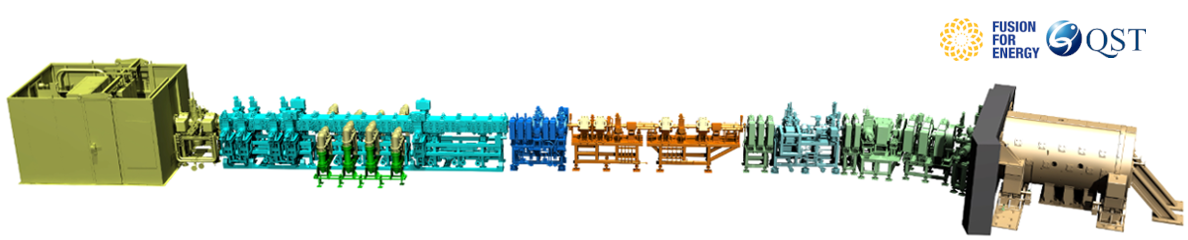

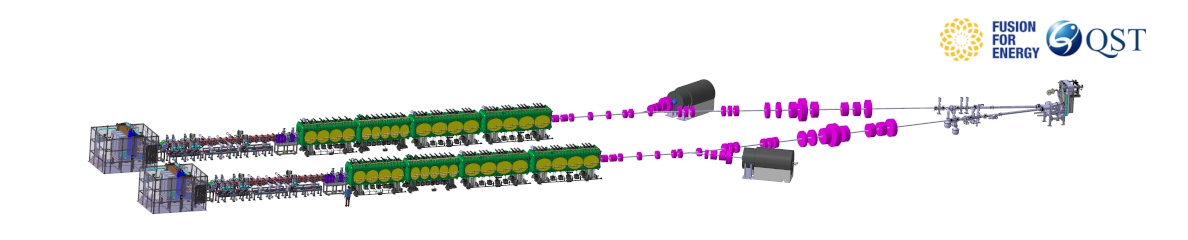
Weekly LIPAc highlights (12/April-16/April)

Injector

The deuteron beam extraction using 6mm Plasma Electrode was paused to fix a sign of corrosion that occurred at the cooling panels in the cubicles of the Power Supplies of the LEBT (Low Energy Beam Transport). The cubicles are located in the RF area, far from the accelerator vault. The corroded part was fixed and an identical cooling panel is being prepared for substitution in the near future. The intervention will be completed on Monday next week and injector conditioning will be resumed.

In VAC02 sector vacuum chamber (placed after the LEBT, at the RFQ entrance) the installation of the new turbo pump and scroll pump was successfully completed.

Radio Frequency (RF) System and RFQ cavity

After the individual tests carried out in the last weeks, the new predrivers have been installed on all RFQ-RF chains. Minor adjustment of the LLRF output level will be necessary.

RF injection in the RFQ cavity was paused at the end of last week as the quality of the cooling water in the RF skid experienced a quick degradation in resistivity. A quick recovery action is on-going and new ion exchange resins should be delivered end of this week for a replacement planned next week. RF injection in RFQ cavity is planned to resume next week.

In the cooling line of one of two Solid State Power Amplifiers (SSPA) the flow meter was disassembled, inspected and cleaned. It was confirmed that a part of flow meter was broken.

In the RFQ cavity all the cryopump groups were regenerated, however one compressor showed higher temperature (~17K) and was stopped. Despite maintenance was carried out on site by the supplier very recently, they suggest to replace a gasket. Analyses are carried out to understand the issue and take actions.

In the RFQ cooling skid the PH of water resulted unexpectedly low, 5.5, which probably indicates a degradation of the demineralizing beds. An intervention was performed this week to check the filters, and two flowmeters. Additionally the RFQ skid was completely drained and refilled with ultrapure water. The PH is now 7.2. Sample of water will be measured weekly until the summer maintenance.

Although a deep maintenance was carried out on the cooling systems in last year long term maintenance, a deep analysis of the recent events is carried out: countermeasures are taken immediately to operate safely the system and corrective measures are planned for the next long term maintenance (starting August 2021).

Medium energy Beam Transport (MEBT) and MEL (MEBT Extension Line)              

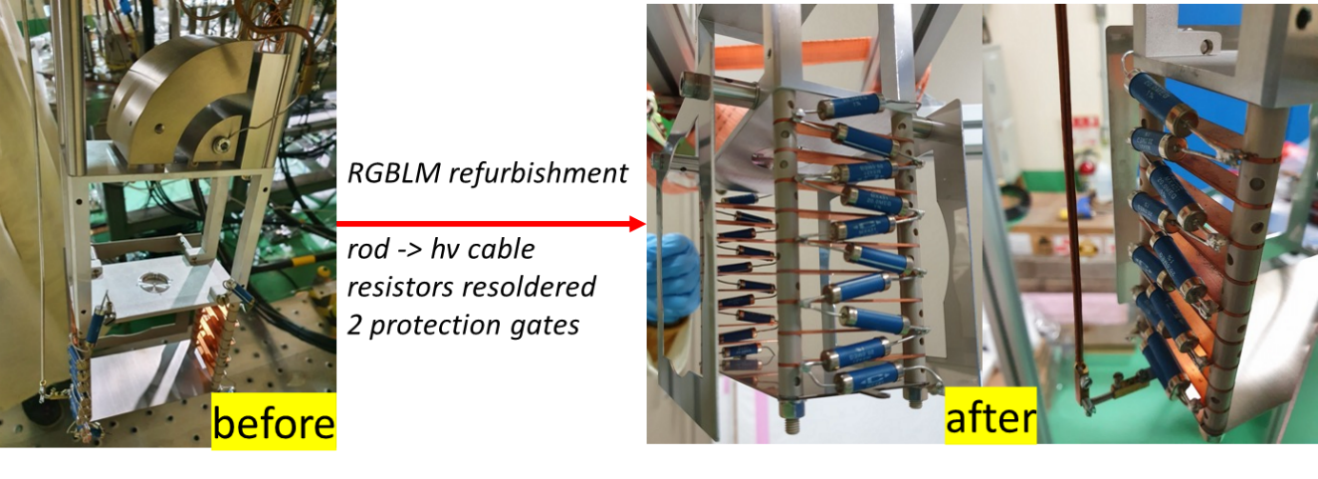
MEBT vacuum is stable at 1e-9 mbar. MEL vacuum was fully recovered after the intervention to install the RGBLM (Residual Gas Bunch Length Monitor) sensor. In the MEBT skid one conductivity sensor and filter were replaced.

Beam Dump

The functional check of the oxygen control loop by monitoring the decrease in oxygen concentration under water circulation (bypassing the BD cartridge itself in the vault) is on-going. The remote sessions with CIEMAT for commissioning and debugging the BD skid control system are on-going (daily remote sessions are carried out!).

Beam Instrumentation

After completion of the installation of the RGBLM sensor in the MEL, the High Voltage checks in vacuum are on-going.

Control System

The new RFQ couplers temperature measurement system was integrated into the RFQ LCS (Local Control System) with the remote support of INFN and operational ?

IT tools for allowing remote participation for RFQ conditioning above 10% of Duty Cycle and for the beam operation are under preparation.

Disclaimer: the information reported is not meant to be technically complete and doesn’t cover all the activities currently carried out on LIPAc. 
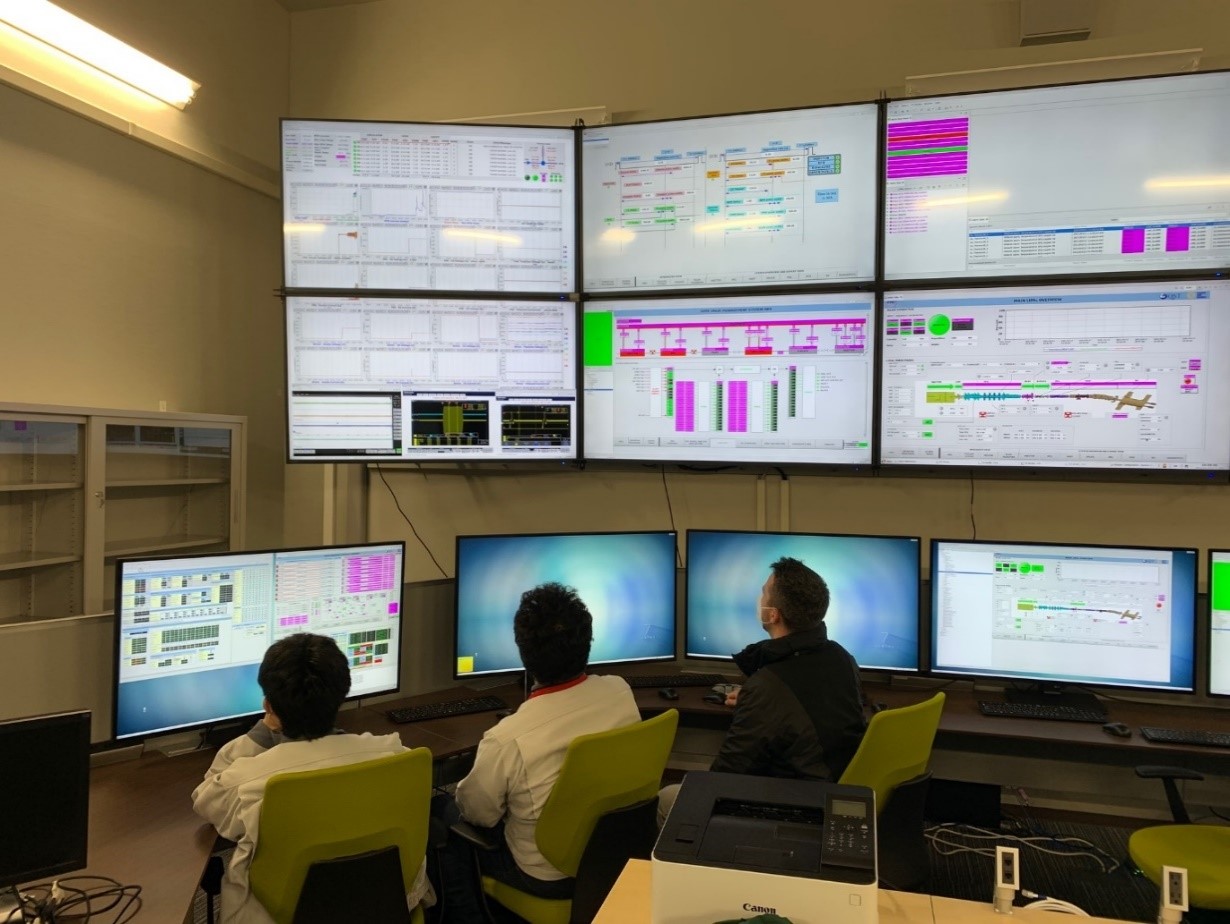
Weekly LIPAc highlights (22/Marh-26/March)

Injector

The proton beam characterization with the 6 mm Plasma Electrode is on-going. The effect of Kr gas injection for controlling the space charge force and reducing the emittance is under investigation. The total extracted beam current achieved so far of 10 to 40 mA can be used for injection in the RFQ. The fractions of proton in the extracted beam are 50% @ 10 mA and 75% @ 30 mA.

Radio Frequency (RF) System and RFQ cavity                                                             

The start-up of the RF system continued. The damaged MicroBox PC used in the RF Water Cooling System (WCS) was repaired: monitoring of the WCS status is essential to hand over to NAT operator the conditioning during the night at low DC. The scheduled tests of the new predrivers continued and now 3 out of 10 have been successfully tested (each test lasts ~8hours). During injection trials into the RFQ cavity the RFPS experienced interlocks and several measures have been already taken: the Protection System (PSYS) of the RF chain 4B has been replaced with a spare, the formerly exchanged PSYS of chains 1B and 3B have been restored, and current instabilities in the circulator temperature compensation coil control (VAT10) are investigated.

Two flowmeters in the RFQ skid showed instabilities and triggered frequent interlocks: short term counter measures have been taken and an intervention on the RFQ skid is being carefully planned (most likely not necessary before next scheduled maintenance).

Thanks to all the efforts of the RF team, the RFPS system is now stable enough and it is planned to handle over soon the system to the NAT operator and start conditioning during the night (at DC<5%).

Beam Dump

The water circulation tests into the oxygen control loop and into the water conductivity control loop are on-going in manual operation mode. This week was fully packed of remote sessions with CIEMAT support to update and debug the BD skid LCS and be able to switch soon the skid to automatic mode.

Disclaimer: the information reported is not meant to be technically complete and doesn’t cover all the activities currently carried out on LIPAc. 
Weekly LIPAc highlights (15/March-19/March)

Injector

After the completion of the PPS test (for the authorization to proceed with the beam extraction), the proton beam extraction has started with the Plasma Electrode having a 6 mm hole. The ramp-up was rather quick: 10-40 mA of proton beam at 5-10% duty cycle were achieved, with good stability and good beam emittance. The Injector is operative from the Central Control room.

Radio Frequency (RF) System and RFQ cavity                                                             

The start-up of the RF system with the calibration of the LLRF (Low Level RF) and the RF chains continued. The check of RF noise issue on the RF system components was systematically investigated; the situation is now improved thanks to remedial actions quickly implemented: grounding meshing is being improved and the newly installed PSYS-LLRF interlock circuit has been modified to inhibit the EMC perturbation. A MicroBox PC used in RF Water Cooling System (WCS) was damaged and it is being replaced: monitoring of the WCS status is essential to hand over at low DC to NAT operator the conditioning during the night. The planned activities to integrate the new RF coupler temperature monitor into the LCS started (remote sessions with INFN took place and are planned).

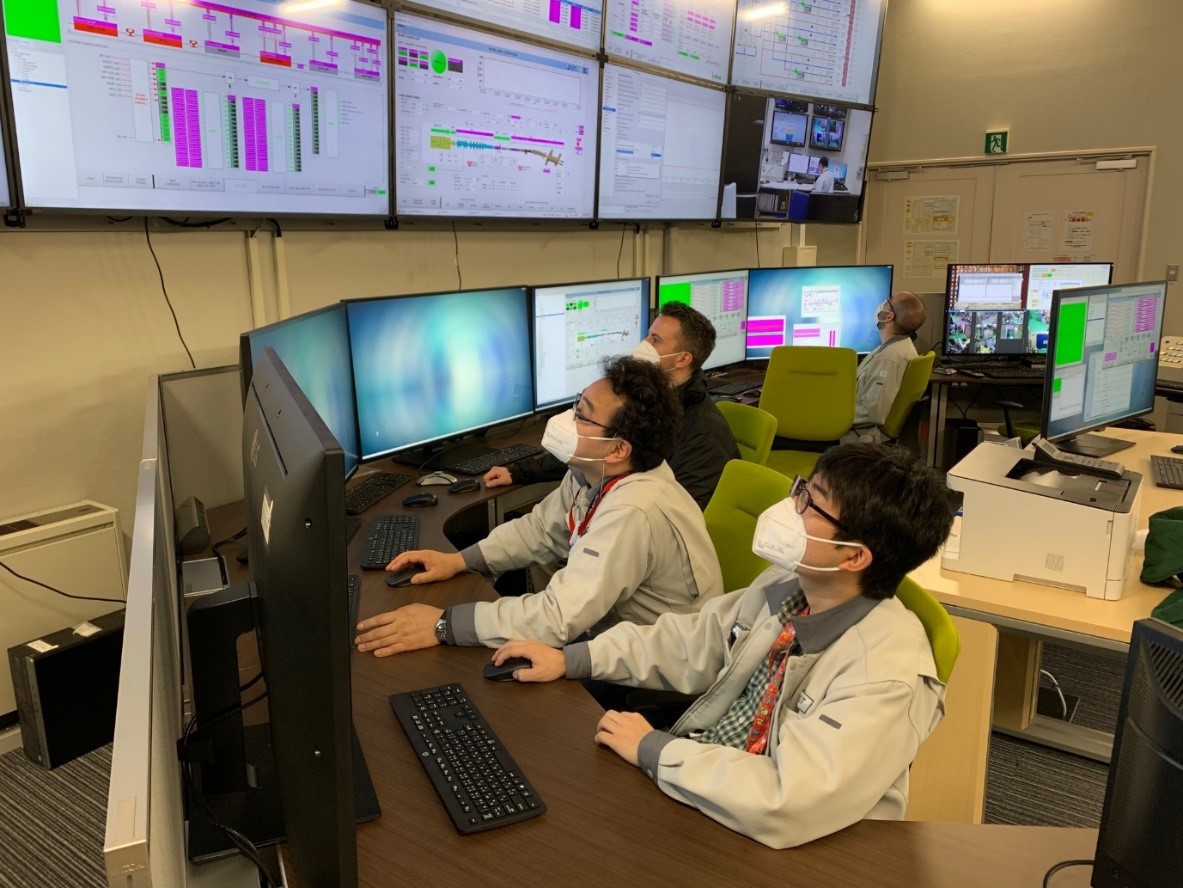
RF injection trials in the RFQ cavity were successfully carried out for the first time from the Central Control Room (CCR)! During RF injection the RFQ vacuum was stable and the temperature rise at the RFQ couplers was <1°C.

RF injection trials in the RFQ cavity carried out for the first time from the Central Control Room

Beam Dump

As part of the BD skid commissioning, the functionality of the recently modified deaeration loop has been confirmed for the first time: under active water circulation in the BD skid the water conductivity was lower than 1uS/cm; operating the vacuum pump of the deaeration loop the dissolved oxygen was decreased from ~2000ppb to ~1600ppb in 20 min.

Currently CIEMAT support is focused on solving PLC issues to adjust sensors and flowmeters calibration and allow the pumps to work in automatic mode.

Beam Instrumentation

After delivery onsite of all the components, the final modification of the RGBLM (Residual Gas Bunch Length Monitor) was completed and the refurbished sensors is now ready to be installed in the vault. The intervention is planned in the week from 29th of March to 2nd of April.

Disclaimer: the information reported is not meant to be technically complete and doesn’t cover all the activities currently carried out on LIPAc. 
Weekly LIPAc highlights (8/March-12/March)

Global Alignment survey

More details on the realignment of the second solenoid magnet (SOL2) of the LEBT (Low Energy Beam Transport) to the entrance of the RFQ completed last week: the achieved tolerance is within 0.1 mm. It is planned to analyse the effects of this change and the measured RFQ-MEBT misalignment by beam dynamics simulation. This will provide key information for the realignment of RFQ-MEBT during the summer maintenance.

Injector

This week the injector vacuum was resumed and insulation test for chopper were completed successfully up to 10 kV. The PPS test for starting plasma and HV conditioning were carried out beginning of the week. HV conditioning of the beam source was completed up to 100kV.

Proton extraction started with the initial main scope to confirm the beam characteristics with the re-installed 6mm plasma electrode.

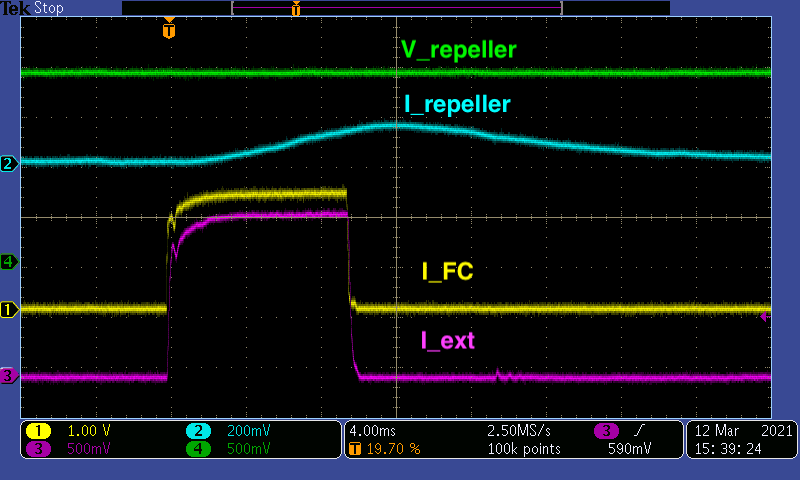
Screenshot of the injector oscilloscope during this week operation with 6mm-PE
  • Duty cycle: 10% (10ms/100ms)
  • Red: Total extracted current (I_ext): 40mA
  • Yellow: Faraday cup signal (I_FC)
  • Blue: Current of repeller PS (I_repeller)
  • Green: Voltage of repeller PS (V_repeller)

Radio Frequency (RF) System and RFQ cavity                                                             

The start-up of the RF system with the calibration of the LLRF (Low Level RF) and the RF chains continued. The check of the RF noise issue on the RF system components continued all the week by increasing the pulse length. The newly installed PYS-LLRF interface to improve the time response of the fast interlock is also improved to cope with spurious interlock generated by the noise issues. During RF injection trials into the RFQ up to 8ms at 1Hz and 128kV were achieved. The RFQ cavity behaviour was good (no instabilities, no interlocks triggered) and up to 4-5% duty cycle no effect was observed on the couplers temperatures. The planned activities to integrate the new RF coupler temperature monitor into the LCS started (remote sessions with INFN are foreseen).

Beam Dump

As part of the BD skid commissioning, the main pump of the BD skid is now operative in manual mode. Circulation in the loop up to the vault and the decay coil was started. It has to be highlighted the remarkable and strenuous effort provided by CIEMAT experts to support remotely the BD skid commission and for solving the LCS and PLC issues.

Disclaimer: the information reported is not meant to be technically complete and doesn’t cover all the activities currently carried out on LIPAc. 
Weekly LIPAc highlights (1/March-5/March)

Global Alignment survey

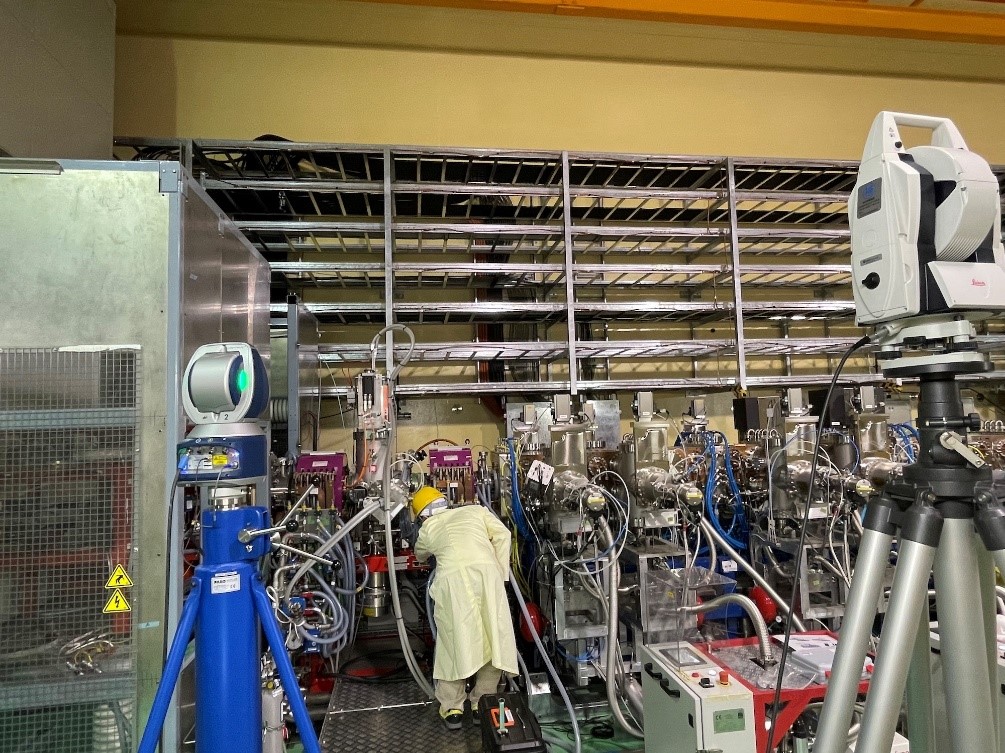
The realignment of the second solenoid magnet (SOL2) of the LEBT (Low Energy Beam Transport) to the entrance of the RFQ was completed this week.

Realignment of the SOL2 magnet of the LEBT

Injector

Following the decision taken earlier in February at management level, at the beginning of this week (before starting the realignment work) the Plasma Electrode (PE) currently installed in the Injector, with a diameter of 11mm, was changed with a PE of 6mm. Also, in the LEBT the chopper was reinstalled after the refurbishment and checkout tests performed in the last months.

Radio Frequency (RF) System and RFQ cavity                                                             

The start-up of the RF system with the calibration of the LLRF (Low Level RF) and the RF chains continued. RF noise issues are currently investigated for flow meters, PSYS-LLRF interface and other interlock signals. During injection in the RFQ cavity 150us/100 Hz @ 132 kV (D+ level) were achieved. The training on the operation of the Solid State Power Amplifiers (SSPA) for the MEBT (Medium energy Beam Transport) bunchers was completed.

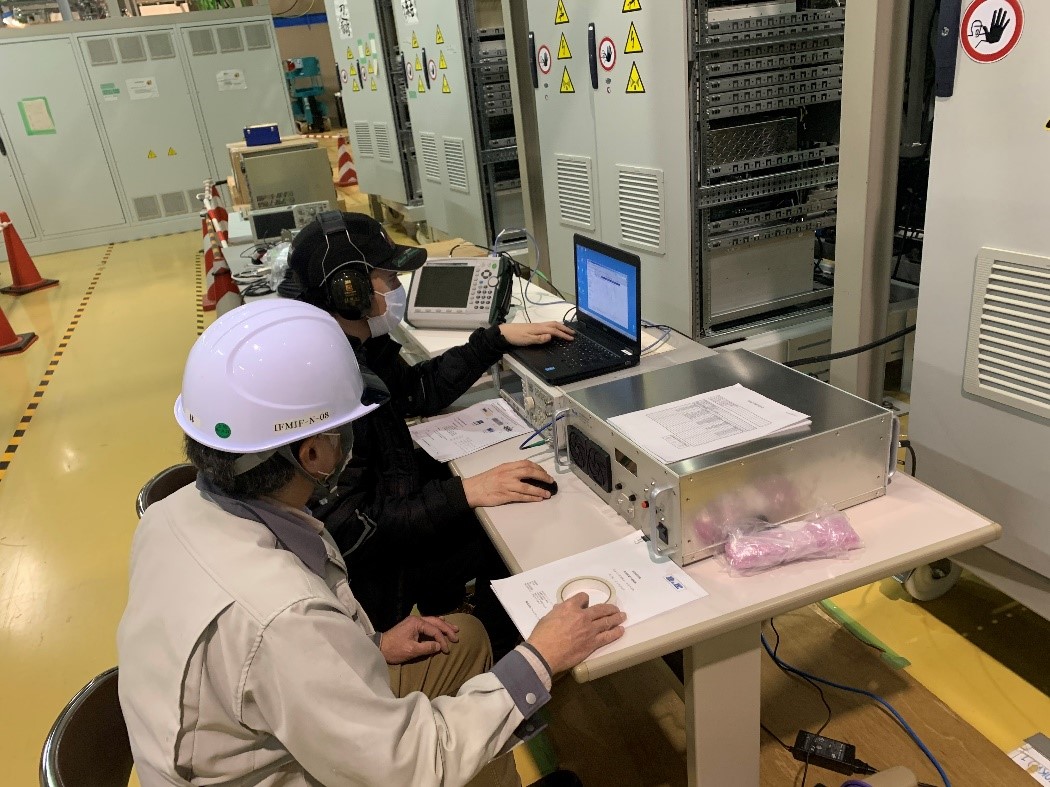
Test preparations in front of RF-RFQ modules in RF area

Disclaimer: the information reported is not meant to be technically complete and doesn’t cover all the activities currently carried out on LIPAc. 
Weekly LIPAc highlights (22/Febuary-26/February)

Global Alignment survey

Additional alignment survey has been completed and the results shared and thoroughly discussed. The realignment of the second solenoid magnet (SOL2) of the LEBT (Low Energy Beam Transport) to the entrance of the RFQ will be performed starting next week. The correction of the alignment between the end of the RFQ and the beginning of the MEBT (Medium Energy Beam Transport) will be performed in the next maintenance period and before starting high duty beam operation. Correction of the mismatch between RFQ and MEBT, considering the size of the RFQ, is challenging and laborious (detailed procedures will be prepared).

Radio Frequency (RF) System and RFQ cavity                                                             

The start-up of the RF system with the calibration of the LLRF (Low Level RF) and the RF chains continued. The installation of Low Pass Filters into the PSYS-LLRF (Protection System – Low Level RF) interface boards was completed. During first RF injections @ 132 kV, D+ level, noise issues on PSYS interlock and water flow meter appear when pulse length exceeds 250us and are under investigation. Check-out of the RFQ cavity with RF injection is pending the completions of these activities.

Beam Dump

As part of the BD skid commissioning, the update of the PLC software for the BD cooling skid is on-going with remote support by CIEMAT.

Disclaimer: the information reported is not meant to be technically complete and doesn’t cover all the activities currently carried out on LIPAc. 
Weekly LIPAc highlights (15/Febuary-19/February)

Global Alignment survey

Additional data for the alignment survey have been collected with highest priority to complete the missing points and improve the accuracy of measurements. The attention is focused in the portions at the end of RFQ and beginning of MEBT. In parallel to the analyses of the data, a procedure to eventually realign those parts is under investigation.

Radio Frequency (RF) System and RFQ cavity                                                             

The start-up of the RF system with the calibration of the LLRF (Low Level RF) and the RF chains continued. The focus was the calibration of the Anode boxes and the installation of Low Pass Filters into the PSYS-LLRF interface boards. Check-out of the RFQ cavity with RF injection is pending the completions of these activities.

Beam Dump

As part of the BD skid commissioning, the update of the PLC software for the BD cooling skid has started with remote support by CIEMAT.

Control System

The Control System team is coordinating the work and ensuring the support of all the teams to complete the preparation of the new Central Control Room for the next beam commissioning and conditioning.

Disclaimer: the information reported is not meant to be technically complete and doesn’t cover all the activities currently carried out on LIPAc. 
Weekly LIPAc highlights (1/Febuary-5/February)

Global Alignment survey

The analyses of the data collected during the global alignment survey of the entire LIPAc accelerator has been completed. Additional measurements of the first RFQ module and of one HEBT magnet are on-going to assess if realignment is necessary.

Radio Frequency (RF) System and RFQ cavity                                                             

The start-up of the RF system with the calibration of the LLRF (Low Level RF) and the RF chains continued this week. The behaviour of the RF cavity during first trials of RF injection is checked as a part of training program.

HEBT (High Energy Beam transport) commissioning

The backup PS for the dipole magnet was delivered on-site and its installation started.

Beam Dump

As part of the BD skid commissioning, the automatic pressure adjustment of the skid using the expansion tank was successfully performed.

Disclaimer: the information reported is not meant to be technically complete and doesn’t cover all the activities currently carried out on LIPAc. 

Weekly LIPAc highlights (25/Janurary-29/January)

Global Alignment survey

The global alignment survey of the entire LIPAc accelerator from ion source to beam dump cartridge has been completed. The large amount of data recorded is being analysed to assess if further measurements or actions are necessary.

RFQ vacuum system

The RFQ nominal vacuum has been resumed smoothly.

Radio Frequency (RF) System   

The start-up of the RF system with the calibration of the LLRF (Low Level RF) and the RF chains including the debugging started this week. The activity focused on the calibration of the 8 RF chains. Next week the plan is to finalize the calibrations, to check the PSYS interlock after the calibration and check the upgraded anode box. Also, some pending software modifications and LCS updates will be performed (activities for which the RF system ON is needed).

Beam Dump

The installation of the planned upgrade in the deaeration loop (oxygen control loop) of the Beam Dump was completed and water circulation is in preparation.

Disclaimer: the information reported is not meant to be technically complete and doesn’t cover all the activities currently carried out on LIPAc. 

Weekly LIPAc highlights (18/Janurary-22/January)

Global Alignment survey

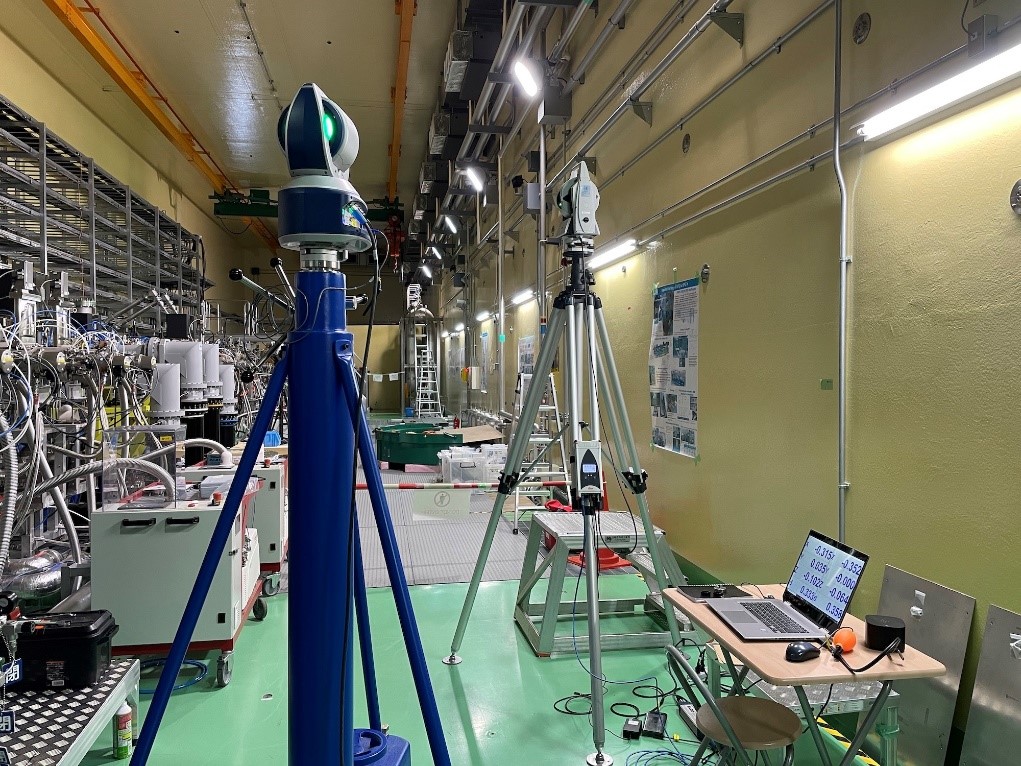
The main activity in the vault in the first part of January has been the global alignment survey of the entire LIPAc accelerator from ion source to beam dump cartridge. The alignment survey has been performed to check that all accelerator components are positioned within the acceptance tolerances. It is the first time that the survey is performed for all the components along the line: as it was observed during the preliminary inspections, this increases the complexity of this laborious activity because the visibility and accessibility of the fiducials markers (i.e. the points of reference for the measurements) is limited. The survey will be completed by the end of this week.  

Laser trackers in position during the alignment survey in the vault.

Radio Frequency (RF) System

The key upgrade of the PYS-LLRF interface to improve the time response of the fast interlock has been propagated to all the RF-RFQ modules. Start-up of the RF system with LLRF (Low Level RF) calibration and RFPS calibration and debugging is planned next week, targeting beginning of February to start RF injection in the RFQ cavity.

RFQ vacuum system

After the planned stop at the end of the year, and in preparation of the RFQ cavity conditioning, the RFQ nominal vacuum will be resumed immediately after completion of the alignment survey, starting all the cryopump groups.

Beam Dump

The installation of the planned upgrade in the deaeration loop (oxygen control loop) of the Beam Dump is ongoing.

Disclaimer: the information reported is not meant to be technically complete and doesn’t cover all the activities currently carried out on LIPAc.